Washington Free Press  Washington State's Nonprofit Journal of News, Ideas, & Culture
home |  subscribe/donate |  article archive |  issue archive |  organization |  volunteer/submit |  activism calendar |  contact us

PEACE & JUSTICE CALENDAR
compiled by
Jean Buskin

August
September
October
All Months


Cartoons of
Dan McConnell

featuring
Tiny the Worm



Latest Posts

TECHNOLOGY

Biodefense, Biolabs and Bugs Seattle City Council takes an important first step to safety Labwatch.org (Aug 9, 2010)

WAR

State of Denial After the big Wikileak, spinning for war Normon Solomon, cartoon by Dan McConnell (Aug 9, 2010)
Daniel Ellsberg to Testify in Tacoma Anti-war Trial event Aug 11 & 12 Lawrence Hildes (Aug 9, 2010)

AROUND WASHINGTON

DinoRossi-saurus, Traffic Ticket Cameras, West Nile Virus, etc. featuring cartoons by Dan McConnell (Aug 9, 2010)

MILITARY

Trident Nuclear Resisters Get Their Day in Court Ground Zero Center (Aug 9, 2010)
Washingtonians Arrested at Tennessee Anti-nuke Action Ground Zero Center (Aug 9, 2010)

LAW

News from the ACLU North Carolina and WA police would like to know your private information with cartoon by John Ambrosavage (Aug 9, 2010)

WORLD

11 Impressions of The West Bank Joel Hanson (Aug 9, 2010)
Israel divestment movement surges in WA OlympiaBDS and TESCdivest, cartoon by George Jartos (Aug 9, 2010)

MEDICINE

How Community Organizing Saved Washington Basic Health Sisters organized for survival Cee Fisher, cartoon by John Jonik (Aug 9, 2010)

ENVIRONMENT

Still More Cartoonists Look at the Oil Spill art by George Jartos, David Logan, and Dan McConnell (Aug 9, 2010)

POLITICS

What Color Is Your -Ism? American reactions to "socialism" and "capitalism" are changing; too bad we don't have either Doug Collins, cartoons by John Ambrosavage (June 5, 2010)

ELECTIONS

Third-Party Candidates Face Long Odds Americans want a change, but change is rarely elected in WA or elsewhere National Institute on Money in State Politics (June 1, 2010)

ENERGY

Cutting the Cost of Cooling Creative conservation for air conditioning and refrigeration Martin Nix (June 1, 2010)

WORKPLACE

Teenage Microsoft Sweatshop 15-hour shifts under poor conditions at Chinese factory from the National Labor Committee (May 16, 2010)

IMMIGRATION

Why US Immigration Policy Needs Tweaking Bill Costello, cartoon by David Logan (May 16, 2010)
Arizona Immigration Brouhaha Various opinions from near and far, cartoons by Logan and McConnell (May 2, 2010)

TRANSPORTATION

The Coming Microcar Revolution Martin Nix (May 16, 2010)

ECONOMY

What the Doomsayers Haven't Been Telling You About Greece Neocons use Europe as a punching bag Steven Hill (May 13, 2010)

POETRY

A Poetic Look at Tacoma Glass Art Museum; a limer-ICK Gerald McBreen (Mar 28, 2010)
Fall Is For Falling Out Of Love, etc. three poems Bob Markey (Mar 29, 2010)

BUSINESS

Who Rules America? Corporate conglomeration is leading to neofeudalism Don Monkerud, cartoon by John Jonik (Mar 27, 2010)

EDUCATION

South Korean Teachers Reach for the SKY Class size doesn't matter as much as teacher quality Bill Costello (Mar 27, 2010)

HEALTH

California Dental Association Says No Fluoridated Water for Infants fluorosis is affecting most children from NYSCOF, art by David Dees (Mar 27, 2010)

CULTURE

Delete the Meat One might become a vegetarian account by John F. Baker, poem by Steve Hood, and cartoon by John Jonik (Feb 22, 2010)
Anvils: An Appreciation essay and photos by Robert Pavlik (Jan 24, 2010)

HISTORY

History of International Women's Day The first celebration was a century ago this year Megan Cornish (Feb 21, 2010)

MILITARY

Why I Do It Resisting Trident for Love and Life Lynne Greenwald (Feb 20, 2010)

TRUTH

Architects and Engineers Ask for New Look at 9/11 Doug Collins (Feb 20, 2010)

MEDIA

Is Olympic Coverage Sexist? Media coverage rarely gives women equal treatment Univ. of Alberta (Jan 24, 2010)

RIGHT BRAIN

Why I Don't Come at Christmas Anymore not-so-jolly Saint Nick (Dec 18, 2009) Santa Gets Political art by Ambrosavage, Lande, and Dees (Dec 17, 2009)

WORKPLACE

No DIME for the Dems WA Labor Council leadership accepts activist platform for economic recovery. Will they follow through? Steve Hoffman (Nov 6, 2009)

RIGHTS

Puyallup Bans Door-to-door Religious Speech ACLU of WA (Oct 16, 2009)

LETTERS

Single-Payer Health; Toilet-Paper Tax READER MAIL with cartoons by Jonik and McConnell (Oct 16, 2009)

SUBSTANCES

FDA Cigarette Regulation is Bad News John Jonik (posted Aug 28, 2009)
A Dose of Reality: Drug Legalization Megan Cornish (posted Aug 28, 2009)

SPORTS

A People's History of Sports BOOK REVIEW Doreen McGrath (posted July 24, 2009)

CLIMATE

Cashing In On Earth's Cycles: Part 3 Alan Cheetham & Richard Kirby (posted July 24, 2009)
Obama: How Serious About Climate Change? Doug Collins (posted July 24, 2009)


What is the Washington Free Press?

The Washington Free Press exists to carry under-reported news and thought-provoking opinion out to a wider audience. We specialize in news related to Washington State. In order to get the news out, we need your reader support to help us pay for basic costs. That's why we ask you to please subscribe and donate. If you would like to help us with writing, editing, or "scouting" for writers and articles, please contact us.

Doug Collins, editor

Google
WWW Washington Free Press

Support the WA Free Press. Non-profit community journalism needs your support. Please subscribe and/or donate.


posted Mar. 27, 2010    Bookmark and Share

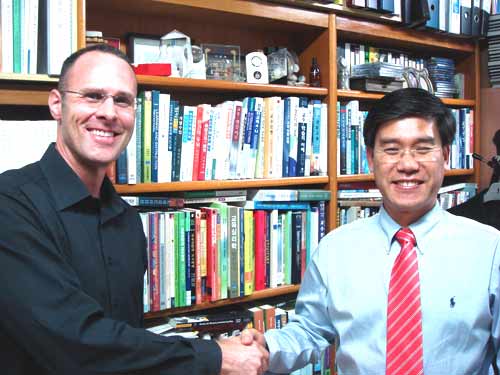
Bill Costello interviews Lim Cheolil, associate professor of education at Seoul National University


South Korean Teachers Reach for the SKY

Class size doesn't matter as much as teacher quality

by Bill Costello


Editor's note: The below article is very thought provoking especially because it provides a strong counterpoint to current US educational norms. However, large class sizes depend on strict classroom discipline, including the absence of outbursts and chitchat in the class. I'm not sure if American educators and parents are culturally prepared to undertake such a system, though I believe strict discipline was the norm here a couple generations ago. Readers, please comment in the feedback section at bottom.


Within South Korea, the three most prestigious universities are Seoul National University, Korea University, and Yonsei University.Collectively, they are referred to by the acronym SKY.

Graduating from a SKY university often leads to a prestigious job with a high salary—especially if the graduate is in the field of education.Opinion polls show that South Koreans view teachers as high-status professionals who make greater contributions to society than any other profession. I recently visited the SKY universities to learn why South Koreans feel this way.

“In Korea, we have a Confucian tradition of respecting teachers,” said Lim Cheolil, associate professor of education at Seoul National University. Beyond tradition, South Korea actively raises the status of teaching as a profession by doing two things. First, it makes entry to teacher training very selective. Teachers are recruited from the top five percent of each high school graduate class. Second, teachers are paid generous starting salaries of 141 percent of GDP per capita, which is significantly above the Organization for Economic Cooperation and Development (OECD) average of 95 percent.

Making teacher training selective and paying teachers high starting salaries attracts the strongest candidates to the teaching profession,which is important because teacher quality significantly impacts student outcomes.

South Korea is able to pay teachers high starting salaries because it employs relatively fewer teachers than other nations. As a result, the student-teacher ratio in South Korea is 30:1, compared to the OECD average of 17:1.

It’s a smart tradeoff because studies show that teacher quality has significantly more impact on student outcomes than class size. Dollar for dollar, it’s better to attract a small number of outstanding teachers with high starting salaries than to attract a large number of mediocre teachers with lower starting salaries—even if that means having a high student-teacher ratio.

In education-obsessed South Korea, the potential for earning a lot of money as a teacher is great. For example, 46-year-old math instructor and cram school tutor Woo Hyeong-cheol makes $4 million a year teaching Web-based classes. His salary is higher than most of the top professional baseball players in South Korea. And he’s just as famous.

Teaching is more than just a high-status profession with a high starting salary in South Korea; it’s also one of the most stable careers. Lee Sang Min, assistant professor of education at Korea University, said: “After the economic crisis in 1997, most Koreans considered stability as the most important thing when choosing a job. Therefore, many university students pursue teaching positions in elementary, middle, and high school.”

Lee Sungho H., professor of education at Yonsei University, agreed: “The most critical reason for being a teacher is job stability. Teachers are guaranteed retirement at age 62. In addition, teaching provides fringe benefits such as summer and winter vacations, a fixed daily time schedule,and a good pension.”

South Korea’s high level of respect for teachers is an exemplar for other nations that want to improve student outcomes.


Bill Costello, M.Ed., is a U.S.-based education columnist, blogger, and author of Awaken Your Birdbrain: Using Creativity to Get What You Want. He can be reached at www.makingmindsmatter.com.


Bookmark and Share

Comments (3)

Please keep comments polite and related to the above page.


#1 - Erik in Seoul - 03/28/2010 - 02:49
Very well written article, but I wonder what your criteria for being a "great teacher" is... That they themselves were bright and went to a prestigious school? I would also be interested to hear more about the studies done on teacher quality vs. class size and how the made their conclusions.
All in all, I think both Korean and American education systems have some things they could teach each other.

#2 - John in Washington State - 04/02/2010 - 18:02
No doubt education in US is misorganized and lacking in many repects, but it is one of the durndest things to change. In one sense there are just too many cooks spoiling the broth. Many of these "cooks"--including the public in general--know nothing about education in the first place, yet like to have "input" in how the schools are operated.

#3 - Doreen M. - 04/04/2010 - 23:00
"John's" comment makes me think that discipline might be the main difference here, rather than class size. How can students really learn if they aren't paying attention?

Name
E-mail (Will not appear online)
Comment
This comment form is powered by GentleSource Comment Script. It can be included in PHP or HTML files and allows visitors to leave comments on the website.