go to WASHINGTON FREE PRESS HOME
(subscribe, contacts, archives, latest, etc.)
July/Aug 1999 issue (#40)
Malaria's New Deadly Toll
by Silja J.A. Talvi, Free Press Contributor
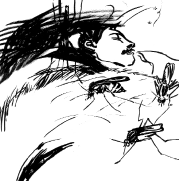
 n any given year, nearly 10 percent of the present-day global population will suffer from a debilitating and often deadly disease that was nearly eliminated in many parts of the world 30 years ago.
Malaria, a unicellular parasitic infection spread by mosquitoes and marked by severe chills and fever, has taken a particular toll on Africa: The continent accounts for 90 percent of the world's malaria cases, and one in 20 African children dies from the disease before the age of five. Experts foresee as much as a 20 percent annual increase in Africa's rate of malaria-related illness and death if the epidemic is left unchecked.
"The worldwide situation can only be viewed as an ongoing disaster. 300-500 million suffer from the disease each year, and 200-300 people die per hour," says Mary Galinski, founder and president of the Malaria Foundation International, a non-profit organization with offices in Atlanta, New York and London.
The malaria epidemic has gained new attention with the release of a report this year by the Geneva-based Global Forum for Health Research (GFHR). The 10/90 Report on Health Research highlights the lack of research and funding toward battling epidemic diseases closely linked with poverty. The most prevalent of these diseases include pneumonia, diarrhea, tuberculosis and malaria.
Of the estimated $56 billion spent annually on health research around the world, less than 10 percent of this amount is devoted to health problems that affect 90 percent of the world's population, explains Louis J. Currat, Executive Secretary of the GFHR.
Malaria research eliminated
Currat explains that Western pharmaceutical companies do not see malaria research as commercially viable and have largely eliminated their research into vaccines or new anti-malarial drugs. Currat, who also serves as the chair of the Medicines for Malaria Venture (MMV), says: "They are worried about how they will recuperate their investments because the development of most drugs cost several hundred million dollars."
Deforestation, global warming, mining and refugee situations have also contributed to the spread of malaria. Mosquitoes thrive in warm, overcrowded areas, and where stagnant pools of water have formed in the absence of natural vegetation and forest. In refugee situations, those who have never before been exposed to strains of malaria are particularly vulnerable to the disease. To compound the problem, IMF and World Bank-imposed structural adjustment policies have slashed the health budgets of less-developed nations over the last two decades. As a consequence, African health ministries and NGOs can't receive the necessary funding or access research to combat malaria's growing productivity and death toll.
The World Health Organization's own malaria prevention program, which relied on the dangerous insecticide DDT to kill mosquitoes, was largely halted in 1969. As a strategy to combat malaria, the temporary use of insecticides proved to be detrimental--mosquitoes quickly evolved resistance and returned with a vengeance. Since that time, both WHO's lackluster attempts to curb the epidemic and the waning interest of economically developed nations in combating the disease further contributed to the growing malaria problem. U.S. government funding for malaria research is less than $73 million a year, while cancer research receives over $2.5 billion in research funding yearly.
In 1997, African countries formed the Multilateral Initiative for Malaria in an attempt to draw attention to this growing health crisis. WHO, under new leadership, responded with an ambitious Roll Back Malaria project in 1998 to try to halve malaria deaths by 2010.
Although the disease is still concentrated in Africa, malaria has spread into Central Asia, Eastern Europe, Central America, and the Middle East. Over the last year, a virulent form of malaria has struck Yemen, affecting nearly 1.5 million people, or ten percent of the population. As in Africa, most deaths in Yemen have occurred among children and pregnant women.
New strains resist treatment
Doctors have discovered strains of malaria on the Thai-Cambodian border that resist all eight drugs currently available to treat the disease, according to Barbara Kancelbaum, communications director of Doctors Without Borders/Medecins Sans Frontieres (MSF). The most common drug, chloroquine, was once known as the most effective, safe and affordable anti-malarial. Over the years, however, chloroquine was often over-prescribed or taken improperly. As with antibiotics, the partial use of anti-malarials has only contributed to further drug resistance.
While the malaria epidemic could be aided with many simple measures--education, inexpensive mosquito bednets, and basic diagnostic equipment--the need for vaccines and new drugs to combat the disease is the most pressing items on the anti-malaria agenda.
"The answer [to why pharmaceutical companies are not researching malaria] is very simple: Malaria drugs are not a profitable market," says Dr. Bernard Pecoul, the Paris-based coordinator of the Access to Essential Medicines campaign launched by MSF. The campaign is geared toward improving drug supply to the developing world.
"But we cannot address the issue only to pharmaceutical companies," continues Dr. Pecoul. "Without incentives from the governments, the companies will not be involved more in research and development."
Circumventing the pharmaceutical companies
Partnership models are a new way to address the problem. A number of groups have recognized the futility of waiting for pharmaceutical companies to develop new anti-malarial drugs and vaccines on their own. These groups are trying to create interest and participation among international aid agencies, the World Bank, governments, NPOs, universities and pharmaceutical companies--and this may lead to a more complete and wide-reaching solution to the growing malaria epidemic.
The Roll Back Malaria initiative was instituted last year under the more proactive leadership of WHO director-general Gro Harlem Brundtland. The G8 countries have pledged their (as yet unspecified) support for Roll Back Malaria--an initiative that was in part a response to the 1997 Multilateral Initiative for Malaria, which was formed to bring attention to the situation in Africa.
Currat is optimistic about this trend toward health research partnerships, and serves as the chair of another RBM-affiliated project, New Medicines for Malaria Venture, which is raising public funding in order to entice pharmaceutical companies to continue anti-malaria research.
Will the involvement of pharmaceutical companies and the World Bank steer attention away from an underlying examination or critique of global health policies? Can there be a re-evaluation of policies that are dictated by considerations of capital and debt-centered structural adjustment policies?
Currat, an economist who worked for the World Bank in the 1970s, strongly downplays such concerns, arguing that the World Bank is on the right track with its current perspectives on health issues and should be centrally represented in organizations like the GFHR.
Public/private health partnerships, explains Currat, are likely to be successful at narrowing the research gap. "The problems are so complex that in order to solve them, the best bet is for the institutions to get together and discuss the problems ... and then each institution starts seeing the problem in its entirety."
Silja J.A. Talvi is a Seattle-based journalist. A version of this article first appeared in In These Times.
go to WASHINGTON FREE PRESS HOME
(subscribe, contacts, archives, etc.)