go to WASHINGTON FREE PRESS HOME
(subscribe, contacts, archives, latest, etc.)
Jan/Feb 1999 issue (#37)
Sink or Swim
And other Films that Will Make You Think
by Emma Wunsch, Free Press contributor
 e all like candy. And Hollywood, with it's mindless plots, beautiful actors, and million dollar budgets seems to give movie viewers nothing but candy; cheap and easy tears, fears and thrills. These big budget, big named movies are not personal or political and are rarely thought-provoking beyond the final credits. But the Grand Illusion's Avant Garde Group Show (Feb.5-11) will present thirteen films that will stay with you long after your last M&M has melted. All the artists included in the show have created films that make you think, feel and question.
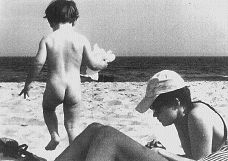
Su Friedrich's Sink or Swim (1990) is a 48-minute emotionally intense autobiographical film, sectioned into 26 short-story-like parts, beginning with the zygote and working its way through alphabet with titles like virginity, kinship, journalism and homework. Friedrich's stories are presented through black and white images, with a child narrating Friedrich's problematic relationship with her father. Sink or Swim, the title taken from Friedrich's father's method of teaching his daughter to swim, is about water; the water itself narrates the story of the filmmaker growing-up as she copes with death, divorce, and the search for meaning within often complicated father-daughter relationships. Sink or Swim is avant-garde in that its frequent non-linear, non-narrative images offer an openness and complexity in the style of such canonical avant garde figures as Maya Dern or Stan Brakhage, but Friedrich's film is accessible, personable, and emotional. What is so wonderful about Sink or Swim is that it seems virtually impossible during the viewing not to think about ones own life/family/relationships/childhood. Films like this, where you think about yourself and the filmmaker as people and not as the attractive mainstream couple on screen, provide the reason for this show. The works of these filmmakers remind us that our lives are the source of art, and our money only buys us candy.
Feb. 5 (7 and 9pm) Five Year Diary by Anne Robertson chronicles Robertson's personal Super-8 documentary of her cure after being institutionalized as a schizo-affective manic depressive. Robertson prefers to think of herself as a "typical anxiety neurotic of the obsessive-compulsive sort, with marked tendencies for fantasy, joy and panic." Robertson, also a performance artist, will narrate and accompany selections from her films in person.
Feb. 6 (1:30, 6:45, & 8:30pm ) Animated Super 8 Punk Rock Poetry by Martha Colburn (3:00&9:45pm) Personal Scopitones by Martha Colburn. Colburn, a self-taught filmmaker, juxtaposes found footage, animated collage, home movies, puppets, paints, and film scratches to off-key vocals, punk rock poetry, and key vocals for short, high energy works. Colburn makes fun of pop culture Americana with titles such There's A Pervert Pool and Hey Tiger along with images of dildos, Oprah getting a black eye, and penguins with breast implants. Colburn will present her films and show off her collection of Scopitiones ( 1960s style music videos).
Feb. 7 ( 5:30, 7:00& 8:45pm) Imprint, Family, Just Words by Louise Borque. The four shorts in Borque's program explore ideas of home, space and family. Borque hand-processes, scratches, and bleaches her film and families' home movies to create surreal qualities of sentiment and dysfunction in her works.
Feb. 8,11 (5,7,9pm Sat. mat. 1&3pm) Gently Down the Stream, Sink or Swim, Rules of the Road by Su Friedrich. Based on the first section of this review, Sink or Swim and the rest of Friedrich's program should not be missed. Gently Down the Stream uses descriptions from Friedrich's journal to exorcise the mysterious power of repeating images while Rules of the Road is the story of a lesbian love affair and it's end, which focuses on the shared beige faux wood-panelled station wagon.
Feb 10,11 (5,7,9pm) The Dead Man, Color of Love, Nocturne by Peggy Ahwesh. Ahwesh, one of the most respected and recognized avant-garde filmmakers, ends the group showing with three films that can be seen as subversive, semi-feminist obscenities. In The Dead Man, Ahwesh tells the story of a naughty girl and pushes the film into both pornographic and political directions. The Color of Love is an anonymous Super 8 hardcore pornography movie Ahwesh found in the garbage. Reprinting the film on an optical printer and adding a tango soundtrack, Ahwesh restored the chemically detoriating film. Nocturne, which premiered at the NY film festival, was shot in film and pixelvision, and explores the limits and extremes of feminity through plot elements from Mario Bava's The Whip and the Flesh and writings from Kathy Acker, the Marquis de Sade, and theorist Steven Shaviro. Shaviro, from the UW's cinema studies program, will introduce Alwesh's program on Wednesday and Friday at 7and 9pm.
The Grand Illusion is located at 1403 NE 50th St. at University Way NE. The general admission price for each program is $6.50.
go to WASHINGTON FREE PRESS HOME
(subscribe, contacts, archives, latest, etc.)