go to WASHINGTON FREE PRESS HOME
(subscribe, contacts, archives, latest, etc.)
Jan/Feb 1999 issue (#37)

by Kent Chadwick
Corridor of Souls
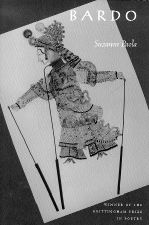
Bardo
by Suzanne Paola
The University of Wisconsin Press, 1998
Paperback, 82 pages, $10.95
 magine your soul in a bodiless state, confused, lost, wishing to escape. You are able to hear and see, wander and choose. You are in the bardo, an intermediate state of the soul, as conceived by Tibetan Buddhism. There are lights beckoning you to rebirth. The green light leads you to rebirth as an animal, the blue light to rebirth as a human being, the white light to rebirth as a god. But to be reborn, even as a god, is to fail to reach nirvana and to plunge again into suffering.
I trust in the bardo wisdom: how the gods
with their soft white light, draw us in, convince us
their stuporous world is all there is.
-- from "Mistaking Opiates for the Clear Light"
Suzanne Paola, an associate professor of English at Western Washington University, has been inspired by the Bardo Thöströl, the Tibetan Book of Liberation Through Hearing in the Intermediate State, which is traditionally read to the corpse for a few days after a person's death. She has used it for both the title and the motifs of her third book of poetry, Bardo, a very good collection that poet Donald Hall selected as the winner of the 1998 Brittingham Prize.
Tibetans read the Bardo Thöströl out loud to help the soul of the dead reject the tempting lights that return one to the material world and instead find the way to Buddhahood. Paola's intentions are more personal and questioning. She brilliantly imagines the drama of a woman unable to conceive from the point of view of the bardo's "corridor of souls:"
What do I pull you to, from your bardo
of indecision ...
To delight in bodily form, said the Buddha, is to delight
in suffering
& you wonder at me,
asking you to want this.
I argue with your perfection, the innocence
you cling to, skyey & unattainable --
-- from "Suite for the Child That Refuses to Come"
The six poems that make up the section "Natural Theology" at the center of Paola's book deal repeatedly with this theme of infertility and loss. And her resolution in the last of those, "Prayer to Seal Up the Wombdoor," is striking in its Robinson Jeffers-styled acclamation of human extinction:
Let my body stay as it is, saying
we have done our damage, all
in the name of imagination: let something else
through its mind, mar
the surfaces of things.
|
Paola reaches deep into the mundane and brings forth compassion |
Paola also uses her Buddhist eye to insightfully describe the way the world is--how the "girl colors" of pink and rose are "blended of blood & milk;" how "to turn woman is to turn body;" how this cosmos is "essentially trivial, meaningless, yet compelling, of a blue so sentimental any modernist would reject it."
But her other eye is Catholic. She finds that "Catholicism and Buddhism cross like electrons in an atom: held by whatever powerful emptiness stabilizes the void." The last section of Bardo draws on the concept of incarnation to help explain the attraction the material world holds for the poet, and leads her, with William Blake, to celebrate "the undersoul: the life in each grain of matter."
Paola has written some beautiful lines in this book:
Scarf of starlings in the air, undulant, leaving--
And, in another example, when she is illustrating a concept from the bardo with the myth of the nymph Daphne, rescued from Apollo's amorous pursuit by her mother who turned her into a laurel tree:
.... But I too have felt the body.
Like Daphne's bark it closes over us.
Paola's line breaks are chosen with skill and help maintain narrative tension in her longer poems.
But many of the lines and stanzas in these twenty-three poems are ordinary, not extraordinary, carefully competent, not excellent. These are poems that you will re-read for their ideas and drama, but not for the sheer beauty of their language or the musicality of their structure.
For example, the following consideration of drugs and consciousness in "In the Realm of Neither Notions nor Not-Notions" is powerful, yet the language itself is stiff without the harmony of excellent lyrical poetry or the crystalline succinctness of the best meditative poetry:
How much heroin did it take to become selfless?
Senseless? A wisp
almost beyond the cold reach of phenomentality?
How much Orange Crush & methadone? I remember
so much just not remembering, a great blank of time
hard & soulless, wonderful
in its purity of conception.
However, in some of her poems, such as "Seeing It All as the Bardo," Paola develops a lyrical rhythm that matches the depth of her thinking. That poem is an ironic journey into a Fred Meyer in which Paola reaches deep into the mundane and brings forth compassion:
I hear the PA system cry out for Betty Rogers to return
to Playland,
& I wonder who Betty Rogers is & why she ever left there.
How human, to wander from a place called Playland ....
go to WASHINGTON FREE PRESS HOME
(subscribe, contacts, archives, latest, etc.)